I just saw that various Digital Humanists on Twitter were talking about representativeness, exclusion of women from digital archives, and other Big Questions. I can only echo my general agreement about most of the comments.
But now that I see some concerns about gender biases in big digital corpora, I do have a bit to say. Partly that I have seen nothing to make me think social prejudices played into the scanning decisions at all. Rather, Google Books, Hathi Trust, the Internet Archive, and all the other similar projects are pretty much representative of the state of academic libraries. (With strange exceptions, of course). You can choose where to vaccum, but not what gets sucked up the machine; likewise the companies.
Showing posts with label Digital Humanities. Show all posts
Showing posts with label Digital Humanities. Show all posts
Tuesday, March 6, 2012

Sunday, February 19, 2012
Second epistle to the intellectual historians
I. The new USIH blogger LD Burnett has a post up expressing ambivalence about the digital humanities because it is too eager to reject books. This is a pretty common argument, I think, familiar to me in less eloquent forms from New York Times comment threads. It's a rhetorically appealing position--to set oneself up as a defender of the book against the philistines who not only refuse to read it themselves, but want to take your books away and destroy them. I worry there's some mystification involved--conflating corporate publishers with digital humanists, lumping together books with codices with monographs, and ignoring the tension between reader and consumer. This problem ties up nicely into the big event in DH in the last week--the announcement of the first issue of the ambitiously all-digital Journal of Digital Humanities. So let me take a minute away from writing about TV shows to sort out my preliminary thoughts on books.
Thursday, June 16, 2011
What's new?
Let me get back into the blogging swing with a (too long—this is why I can't handle Twitter, folks) reflection on an offhand comment. Don't worry, there's some data stuff in the pipe, maybe including some long-delayed playing with topic models.
Even at the NEH's Digging into Data conference last weekend, one commenter brought out one of the standard criticisms of digital work—that it doesn't tell us anything we didn't know before. The context was some of Gregory Crane's work in describing shifting word use patterns in Latin over very long time spans (2000 years) at the Perseus Project: Cynthia Damon, from Penn, worried that "being able to represent this as a graph instead by traditional reading is not necessarily a major gain." That is to say, we already know this; having a chart restate the things any classicist could tell you is less than useful. I might have written down the quote wrong; it doesn't really matter, because this is a pretty standard response from humanists to computational work, and Damon didn't press the point as forcefully as others do. Outside the friendly confines of the digital humanities community, we have to deal with it all the time.
Even at the NEH's Digging into Data conference last weekend, one commenter brought out one of the standard criticisms of digital work—that it doesn't tell us anything we didn't know before. The context was some of Gregory Crane's work in describing shifting word use patterns in Latin over very long time spans (2000 years) at the Perseus Project: Cynthia Damon, from Penn, worried that "being able to represent this as a graph instead by traditional reading is not necessarily a major gain." That is to say, we already know this; having a chart restate the things any classicist could tell you is less than useful. I might have written down the quote wrong; it doesn't really matter, because this is a pretty standard response from humanists to computational work, and Damon didn't press the point as forcefully as others do. Outside the friendly confines of the digital humanities community, we have to deal with it all the time.
Wednesday, April 13, 2011
In search of the great white whale
All the cool kids are talking about shortcomings in digitized text databases. I don't have anything so detailed to say as what Goose Commerce or Shane Landrum have gone into, but I do have one fun fact. Those guys describe ways that projects miss things we might think are important but that lie just outside the most mainstream interests—the neglected Early Republic in newspapers, letters to the editor in journals, etc. They raise the important point that digital resources are nowhere near as comprehensive as we sometimes think, which is a big caveat we all need to keep in mind. I want to point out that it's not just at the margins we're missing texts: omissions are also, maybe surprisingly, lurking right at the heart of the canon. Here's an example.


Sunday, April 3, 2011
Stopwords to the wise
Shane Landrum (@cliotropic) says my claim that historians have different digital infrastructural needs than other fields might be provocative. I don't mean this as exceptionalism for historians, particularly not compared to other humanities fields. I do think historians are somewhat exceptional in the volume of texts they want to process—at Princeton, they often gloat about being the heaviest users of the library. I do think this volume is one important reason English has a more advanced field of digital humanities than history does. But the needs are independent of the volume, and every academic field has distinct needs. Data, though, is often structured for either one set of users, or for a mushy middle.
A particularly clear connection is from database structures to "categories of analysis" in our methodology. Since humanists share methods in a lot of ways, digital resources designed for one humanities discipline will carry well for others. But it's quite possible to design a resource that makes extensive use of certain categories of analysis nearly impossible.
One clear-cut example: ancestry.com. The bulk of interest in digitized census records lies in two groups: historians and genealogists. That web site is clearly built for the latter: it has lots of genealogy-specific features built into the database for matching sound-alike names and misspellings, for example, but almost nothing for social history. (I'm pretty sure you can't use it to find German cabinet-makers in Camden in 1850, for example.) Ancestry.com views names (last names in particular) as the most important field and structures everything else around serving those up. Lots of historians are more interested in the place or the profession or the ancestry fields in the census: what we take as a unit of analysis affects what we want to see database indexes and search terms built around. (And that's not even getting into the question of aggregating the records into statistics.)
A particularly clear connection is from database structures to "categories of analysis" in our methodology. Since humanists share methods in a lot of ways, digital resources designed for one humanities discipline will carry well for others. But it's quite possible to design a resource that makes extensive use of certain categories of analysis nearly impossible.
One clear-cut example: ancestry.com. The bulk of interest in digitized census records lies in two groups: historians and genealogists. That web site is clearly built for the latter: it has lots of genealogy-specific features built into the database for matching sound-alike names and misspellings, for example, but almost nothing for social history. (I'm pretty sure you can't use it to find German cabinet-makers in Camden in 1850, for example.) Ancestry.com views names (last names in particular) as the most important field and structures everything else around serving those up. Lots of historians are more interested in the place or the profession or the ancestry fields in the census: what we take as a unit of analysis affects what we want to see database indexes and search terms built around. (And that's not even getting into the question of aggregating the records into statistics.)
Wednesday, March 2, 2011
What historians don't know about database design…
I've been thinking for a while about the transparency of digital infrastructure, and what historians need to know that currently is only available to the digitally curious. They're occasionally stirred by a project like ngrams to think about the infrastructure, but when that happens they only see the flaws. But those problems—bad OCR, inconsistent metadata, lack of access to original materials—are present to some degree in all our texts.
One of the most illuminating things I've learned in trying to build up a fairly large corpus of texts is how database design constrains the ways historians can use digital sources. This is something I'm pretty sure most historians using jstor or google books haven't thought about at all. I've only thought about it a little bit, and I'm sure I still have major holes in my understanding, but I want to set something down.
Historians tend to think of our online repositories as black boxes that take boolean statements from users, apply it to data, and return results. We ask for all the books about the Soviet Union written before 1917, Google spits it back. That's what computers aspire to. Historians respond by muttering about how we could have 13,000 misdated books for just that one phrase. The basic state of the discourse in history seems to be stuck there. But those problems are getting fixed, however imperfectly. We should be muttering instead about something else.
Sunday, February 20, 2011
Vector Space, overlapping genres, and the world beyond keyword search
I wanted to see how well the vector space model of documents I've been using for PCA works at classifying individual books. [Note at the outset: this post swings back from the technical stuff about halfway through, if you're sick of the charts.] While at the genre level the separation looks pretty nice, some of my earlier experiments with PCA, as well as some of what I read in the Stanford Literature Lab's Pamphlet One, made me suspect individual books would be sloppier. There are a couple different ways to ask this question. One is to just drop the books as individual points on top of the separated genres, so we can see how they fit into the established space. By the first two principal components, for example, we can make all the books in LCC subclasses "BF" (psychology) blue, and use red for "QE" (Geology), overlaying them on a chart of the first two principal components like I've been using for the last two posts:
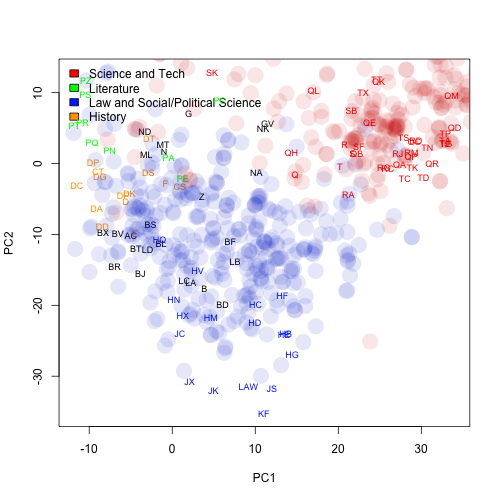
That's a little worse than I was hoping. Generally the books stay close to their term, but there is a lot of variation, and even a little bit of overlap. Can we do better? And what would that mean?

That's a little worse than I was hoping. Generally the books stay close to their term, but there is a lot of variation, and even a little bit of overlap. Can we do better? And what would that mean?

Friday, February 11, 2011
Going it alone
I've spent a lot of the last week trying to convince Princeton undergrads it's OK to occasionally disagree with each other, even if they're not sure they're right. So let me make one of my notes on one of the places I've felt a little bit of skepticism as I try to figure what's going on with the digital humanities.
Since I'm late to the party, I've been trying to catch up a bit on where the field is now. One thing that jumped out is how wide-ranging the hopes are for what the digital humanities might do if they take over the existing disciplines or create their own. Being a bit of a job market determinist myself, I wonder if the wreckage many see in the current structure of the humanities doesn't promote a little bit of millenarian strand about how great the reconstruction might be. I feel occasionally I've stumbled into Moscow 1919 or Paris 1968; there are manifestos, there are spontaneous leaderless youth, and in the wreckage of the old system, anything seems possible for the new technological man. Digital humanities, to exaggerate the claims, will create the mass audience academic historians have lost, will reaffirm the importance of public history in the field, will create new fields with new jobs, will break down the boundaries between disciplines, will allow collaborative history to finally emerge. And it might be in danger if it's co-opted by the powers-that-be, as John Unsworth finds many worrying (pdf).
Paris 1968 is an exciting place to be. I've been watching Al-Jazeera all week. But all these transformations promised by DH won't happen all at once, and some of them won't happen at all. As I try to write some of this up for a Princeton audience (which is why, along with the start of our term last week, I'm not blogging much right now) I'm thinking about what it takes to get skeptical historians on board, and what parts of the promised land might put them off.
The thing I'm mulling over: collaboration. A colleague said to me yesterday he thought the digital humanities will come and go before most historians ever stopped working alone, and I think I tend to agree. I'm pretty much agnostic on the need for collaborative history, myself. Certainly, digital humanities open up fascinating new prospects for collaborative projects. But so far as we're trying to get anyone established on board, an insistence on collaboration might be as much a liability as a benefit. I'm signing up for a THATcamp, but I have to admit a bit of trepidation about putting in volunteer work onto anything that isn't mine. Not just for selfishness, but because we often have funny standards about academic work it's difficult to impose on others. I went to a talk this week where one participant says he refuses to use the words "idea" or "concept." No one can live up to all the constraints we might want to put on work, but it's often fascinating to see what people come up with when we let them do things wholly their own way. Labs aren't always amenable to humanist practices because it's critically important for the health of our disciplines that we don't agree on methodology.
Luckily, then, I've been most struck by in the last couple months is how far one can go it alone right now--unlike the early years of humanities computing (or so I gather), you don't need teams to get computing time, all the truly technical work of digitization, OCR, and cataloging has been done by groups like the Internet Archive, and free software makes it possible to get started on some forms of analysis quite quickly. It's quite possible for someone at a university without any digital humanities infrastructure to do work in text mining or GIS without having a full lab or collaborative team behind them. Sure, it's harder than firing up an iPad app; but I'm not sure it's that much worse than all the commands plenty of senior academics learned in the dark ages to check their e-mail on pine or elm.
What about all the collaborative the labs and programs we already have? Clearly they do more than anything to advance the field, and it's hard to imagine all the great work coming out of GMU or Stanford (say) happening with lone scholars. But it's equally hard for me to imagine that the digital humanities will have actually succeeded until there's a lot of good work coming out that doesn't need the collaborative model, and that answers to some of the expectations of solitary scholars about how humanistic work is produced. At least, that's what I'm thinking for now.
Since I'm late to the party, I've been trying to catch up a bit on where the field is now. One thing that jumped out is how wide-ranging the hopes are for what the digital humanities might do if they take over the existing disciplines or create their own. Being a bit of a job market determinist myself, I wonder if the wreckage many see in the current structure of the humanities doesn't promote a little bit of millenarian strand about how great the reconstruction might be. I feel occasionally I've stumbled into Moscow 1919 or Paris 1968; there are manifestos, there are spontaneous leaderless youth, and in the wreckage of the old system, anything seems possible for the new technological man. Digital humanities, to exaggerate the claims, will create the mass audience academic historians have lost, will reaffirm the importance of public history in the field, will create new fields with new jobs, will break down the boundaries between disciplines, will allow collaborative history to finally emerge. And it might be in danger if it's co-opted by the powers-that-be, as John Unsworth finds many worrying (pdf).
Paris 1968 is an exciting place to be. I've been watching Al-Jazeera all week. But all these transformations promised by DH won't happen all at once, and some of them won't happen at all. As I try to write some of this up for a Princeton audience (which is why, along with the start of our term last week, I'm not blogging much right now) I'm thinking about what it takes to get skeptical historians on board, and what parts of the promised land might put them off.
The thing I'm mulling over: collaboration. A colleague said to me yesterday he thought the digital humanities will come and go before most historians ever stopped working alone, and I think I tend to agree. I'm pretty much agnostic on the need for collaborative history, myself. Certainly, digital humanities open up fascinating new prospects for collaborative projects. But so far as we're trying to get anyone established on board, an insistence on collaboration might be as much a liability as a benefit. I'm signing up for a THATcamp, but I have to admit a bit of trepidation about putting in volunteer work onto anything that isn't mine. Not just for selfishness, but because we often have funny standards about academic work it's difficult to impose on others. I went to a talk this week where one participant says he refuses to use the words "idea" or "concept." No one can live up to all the constraints we might want to put on work, but it's often fascinating to see what people come up with when we let them do things wholly their own way. Labs aren't always amenable to humanist practices because it's critically important for the health of our disciplines that we don't agree on methodology.
Luckily, then, I've been most struck by in the last couple months is how far one can go it alone right now--unlike the early years of humanities computing (or so I gather), you don't need teams to get computing time, all the truly technical work of digitization, OCR, and cataloging has been done by groups like the Internet Archive, and free software makes it possible to get started on some forms of analysis quite quickly. It's quite possible for someone at a university without any digital humanities infrastructure to do work in text mining or GIS without having a full lab or collaborative team behind them. Sure, it's harder than firing up an iPad app; but I'm not sure it's that much worse than all the commands plenty of senior academics learned in the dark ages to check their e-mail on pine or elm.
What about all the collaborative the labs and programs we already have? Clearly they do more than anything to advance the field, and it's hard to imagine all the great work coming out of GMU or Stanford (say) happening with lone scholars. But it's equally hard for me to imagine that the digital humanities will have actually succeeded until there's a lot of good work coming out that doesn't need the collaborative model, and that answers to some of the expectations of solitary scholars about how humanistic work is produced. At least, that's what I'm thinking for now.
Friday, January 21, 2011
Digital history and the copyright black hole
In writing about openness and the ngrams database, I found it hard not to reflect a little bit about the role of copyright in all this. I've called 1922 the year digital history ends before; for the kind of work I want to see, it's nearly an insuperable barrier, and it's one I think not enough non-tech-savvy humanists think about. So let me dig in a little.
The Sonny Bono Copyright Term Extension Act is a black hole. It has trapped 95% of the books ever written, and 1922 lies just outside its event horizon. Small amounts of energy can leak out past that barrier, but the information they convey (or don't) is miniscule compared to what's locked away inside. We can dive headlong inside the horizon and risk our work never getting out; we can play with the scraps of radiation that seep out and hope it adequately characterizes what's been lost inside; or we can figure out how to work with the material that isn't trapped to see just what we want. I'm in favor of the latter: let me give a bit of my reasoning why.
My favorite individual ngram is for the zip code 02138. It is steadily persistent from 1800 to 1922, and then disappears completely until the invention of the zip code in the 1960s. Can you tell what's going on?

The Sonny Bono Copyright Term Extension Act is a black hole. It has trapped 95% of the books ever written, and 1922 lies just outside its event horizon. Small amounts of energy can leak out past that barrier, but the information they convey (or don't) is miniscule compared to what's locked away inside. We can dive headlong inside the horizon and risk our work never getting out; we can play with the scraps of radiation that seep out and hope it adequately characterizes what's been lost inside; or we can figure out how to work with the material that isn't trapped to see just what we want. I'm in favor of the latter: let me give a bit of my reasoning why.
My favorite individual ngram is for the zip code 02138. It is steadily persistent from 1800 to 1922, and then disappears completely until the invention of the zip code in the 1960s. Can you tell what's going on?

Thursday, January 20, 2011
Openness and Culturomics
The Culturomics authors released a FAQ last week that responds to many of the questions floating around about their project. I should, by trade, be most interested in their responses to the lack of humanist involvement. I'll get to that in a bit. But instead, I find myself thinking more about what the requirements of openness are going to be for textual research.
Saturday, December 4, 2010
Today's Times Article
Patricia Cohen's new article about the digital humanities doesn't come with the rafts of crotchety comments the first one did, so unlike last time I'm not in a defensive crouch. To the contrary: I'm thrilled and grateful that Dan Cohen, the main subject of the article, took the time in his moment in the sun to link to me. The article itself is really good, not just because the Cohen-Gibbs Victorian project is so exciting, but because P. Cohen gets some thoughtful comments and the NYT graphic designers, as always, do a great job. So I just want to focus on the Google connection for now, and then I'll post my versions of the charts the Times published.
Friday, December 3, 2010
Quick, extremely relevant outlinks
Dan Cohen, the hub of all things digital history, in the news and on his blog.
Thursday, December 2, 2010
Do it yourself
Jamie's been asking for some thoughts on what it takes to do this--statistics backgrounds, etc. I should say that I'm doing this, for the most part, the hard way, because 1) My database is too large to start out using most tools I know of, including I think the R text-mining package, and 2) I want to understand how it works better. I don't think I'm going to do the software review thing here, but there are what look like a lot of promising leads at an American Studies blog.
As for whether the courses exist, I think they do from place to place: Stephen Ramsay says he's taught one at Nebraska for years.
It's easy to follow a few of these links and quickly end up drinking from a firehose of information. I get two initial impressions: 1) English is ahead of history on this; 2) there are a lot of highly developed applications for doing similar things with text analysis. The advantage is that it's leading me to think more carefully about how my applications are different than other people's.
As for whether the courses exist, I think they do from place to place: Stephen Ramsay says he's taught one at Nebraska for years.
It's easy to follow a few of these links and quickly end up drinking from a firehose of information. I get two initial impressions: 1) English is ahead of history on this; 2) there are a lot of highly developed applications for doing similar things with text analysis. The advantage is that it's leading me to think more carefully about how my applications are different than other people's.
Wednesday, December 1, 2010
Digital Humanities and Humanities Computing
I've had "digital humanities" in the blog's subtitle for a while, but it's a terribly offputting term. I guess it's supposed to evoke future frontiers and universal dissemination of humanistic work, but it carries an unfortunate implication that the analog humanities are something completely different. It makes them sound older, richer, more subtle—and scheduled for demolition. No wonder a world of online exhibitions and digital texts doesn't appeal to most humanists of the tweed– and dust-jacket crowd. I think we need a distinction that better expresses how digital technology expands the humanities, rather than constraining it.
It's too easy to think Digital Humanities is about teaching people to think like computers, when it really should be about making computers think like humanists.* What we want isn't digital humanities; it's humanities computing. To some degree, we all know this is possible—we all think word processors are better than pen and paper, or jstor better than buried stacks of journals (musty musings about serendipity aside). But we can go farther than that. Manfred Kuehn's blog is an interesting project in exploring how notetaking software can reflect and organize our thinking in ways that create serendipity within one person's own notes. I'm trying to figure out ways of doing that on a larger body of texts, but we could think of those as notes, themselves.
Programming and other Languages
Jamie asked about assignments for students using digital sources. It's a difficult question.
A couple weeks ago someone referred an undergraduate to me who was interested in using some sort of digital maps for a project on a Cuban emigre writer like the ones I did of Los Angeles German emigres a few years ago. Like most history undergraduates, she didn't have any programming background, and she didn't have a really substantial pile of data to work with from the start. For her to do digital history, she'd have to type hundreds of addresses and dates off of letters from the archives, and then learn some sort of GIS software or google maps API, without any clear payoff. No would get much out of forcing her to spend three days playing with databases when she's really looking at the contents of letters.
Sunday, November 28, 2010
Top ten authors
Most intensive text analysis is done on heavily maintained sources. I'm using a mess, by contrast, but a much larger one. Partly, I'm doing this tendentiously--I think it's important to realize that we can accept all the errors due to poor optical character recognition, occasional duplicate copies of works, and so on, and still get workable materials.
Using worse sources is something of a necessity for digital history. The text recognition and the metadata for a lot of the sources we use often—google books, jstor, proquest—is full of errors under the surface, and it's OK for us to work with such data in the open. The historical profession doesn't have any small-ish corpuses we would be interested in analyzing again and again. This isn't true of English departments, who seem to be well ahead of historians in computer-assisted text analysis, and have the luxury of emerging curated text sources like the one Martin Mueller describes here.
But the side effect of that is that we need to be careful about understanding what we're working with. So I'm running periodic checks on the data in my corpus of books by major American publishers (described more earlier) to see what's in there. I thought I'd post the list of the top twenty authors, because I found it surprising, though not in a bad way. We'll do from no. 20 ranking on up, because that's how they do it on sports blogs. (What I really should do is a slideshow to increase pageviews). I'll identify the less famous names.
Using worse sources is something of a necessity for digital history. The text recognition and the metadata for a lot of the sources we use often—google books, jstor, proquest—is full of errors under the surface, and it's OK for us to work with such data in the open. The historical profession doesn't have any small-ish corpuses we would be interested in analyzing again and again. This isn't true of English departments, who seem to be well ahead of historians in computer-assisted text analysis, and have the luxury of emerging curated text sources like the one Martin Mueller describes here.
But the side effect of that is that we need to be careful about understanding what we're working with. So I'm running periodic checks on the data in my corpus of books by major American publishers (described more earlier) to see what's in there. I thought I'd post the list of the top twenty authors, because I found it surprising, though not in a bad way. We'll do from no. 20 ranking on up, because that's how they do it on sports blogs. (What I really should do is a slideshow to increase pageviews). I'll identify the less famous names.
Thursday, November 18, 2010
More on Grafton
One more note on that Grafton quote, which I'll post below.
“The digital humanities do fantastic things,” said the eminent Princeton historian Anthony Grafton. “I’m a believer in quantification. But I don’t believe quantification can do everything. So much of humanistic scholarship is about interpretation.”
“It’s easy to forget the digital media are means and not ends,” he added.Anne pointed out at dinner that the reason this is so frustrating is because it gives far too much credit to quantification. Grafton has tossed out all the history of science he's been so involved in and pretends he thinks that the quantitative sciences use numbers to reveal irrefutable facts about the world. I'm sure there are people who do believe that they unearth truth through elaborate cliometrics; but those oddballs are far less harmful and numerous than those who think the humanities are about 'interpretations', and the sciences about 'facts.' Again, I bet this in some way this is a misstatement or misquotation. Still, it made it through because it's so representative of how a lot of the profession thinks.
(more below the break)
Wednesday, November 17, 2010
Moscow and NyTimes
I'm in Moscow now. I still have a few things to post from my layover, but there will be considerably lower volume through Thanksgiving.
I don't want to comment too much on yesterday (today's? I can't tell anymore) article about digital humanities in the New York Times, but a couple e-mail people e-mailed about it. So a couple random points:
1. Tony Grafton is, as always, magnanimous: but he makes an unfortunate distinction between "data" and "interpretation" that gives others cover to view digital humanities less charitably than he does. I shouldn't need to say this, but: the whole point of data is that it gives us new objects of interpretation. And the Grafton school of close reading, which seems to generally now involve writing a full dissertation on a single book, is also not a substitute for the full range of interpretive techniques that play on humanistic knowledge.
(more after the break)
I don't want to comment too much on yesterday (today's? I can't tell anymore) article about digital humanities in the New York Times, but a couple e-mail people e-mailed about it. So a couple random points:
1. Tony Grafton is, as always, magnanimous: but he makes an unfortunate distinction between "data" and "interpretation" that gives others cover to view digital humanities less charitably than he does. I shouldn't need to say this, but: the whole point of data is that it gives us new objects of interpretation. And the Grafton school of close reading, which seems to generally now involve writing a full dissertation on a single book, is also not a substitute for the full range of interpretive techniques that play on humanistic knowledge.
(more after the break)
Friday, November 12, 2010
Wordcounts in starting research--what do we have now?
All right, let's put this machine into action. A lot of digital humanities is about visualization, which has its place in teaching, which Jamie asked for more about. Before I do that, though, I want to show some more about how this can be a research tool. Henry asked about the history of the term 'scientific method.' I assume he was asking a chart showing its usage over time, but I already have, with the data in hand, a lot of other interesting displays that we can use. This post is a sort of catalog of what some of the low-hanging fruit in text analysis are.
The basic theory I'm working on here is that textual analysis isn't necessarily about answering research questions. (It's not always so good at doing that.) It can also help us channel our thinking into different directions. That's why I like to use charts and random samples rather than lists--they can help us come up with unexpected ideas, and help us make associations that wouldn't come naturally. Essentially, it's a different form of reading--just like we can get different sorts of ideas from looking at visual evidence vs. textual evidence, so can we get yet other ideas by reading quantitative evidence. The last chart in the post is good for that, I think. But first things first: the total occurrences of "scientific method" per thousand words.

This is what we've already had. But now I've finally got those bookcounts running too. Here is the number of books per thousand* that contain the phrase "scientific method":
The basic theory I'm working on here is that textual analysis isn't necessarily about answering research questions. (It's not always so good at doing that.) It can also help us channel our thinking into different directions. That's why I like to use charts and random samples rather than lists--they can help us come up with unexpected ideas, and help us make associations that wouldn't come naturally. Essentially, it's a different form of reading--just like we can get different sorts of ideas from looking at visual evidence vs. textual evidence, so can we get yet other ideas by reading quantitative evidence. The last chart in the post is good for that, I think. But first things first: the total occurrences of "scientific method" per thousand words.
Wednesday, November 10, 2010
digitizecr by ljooq ic
Obviously, I like charts. But I've periodically been presenting data as a number of random samples, as well. It's a technique that can be important for digital humanities analysis. And it's one that can draw more on the skills in humanistic training, so might help make this sort of work more appealing. In the sciences, an individual data point often has very little meaning on its own--it's just a set of coordinates. Even in the big education datasets I used to work with, the core facts that I was aggregating up from were generally very dull--one university awarded three degrees in criminal science in 1984, one faculty member earned $55,000 a year. But with language, there's real meaning embodied in every point, that we're far better equipped to understand than the computer. The main point of text processing is to act as a sort of extraordinarily stupid and extraordinarily perseverant research assistant, who can bring patterns to our attention but is terrible at telling which patterns are really important. We can't read everything ourselves, but it's good to check up periodically--that's why I do things like see what sort of words are the 300,000th in the language, or what 20 random book titles from the sample are.
So any good text processing application will let us delve into the individual data as well as giving the individual picture. I'm circling around something commenter "Jamie" said, though not addressing it directly: (quote after break)
So any good text processing application will let us delve into the individual data as well as giving the individual picture. I'm circling around something commenter "Jamie" said, though not addressing it directly: (quote after break)
Subscribe to:
Posts (Atom)